
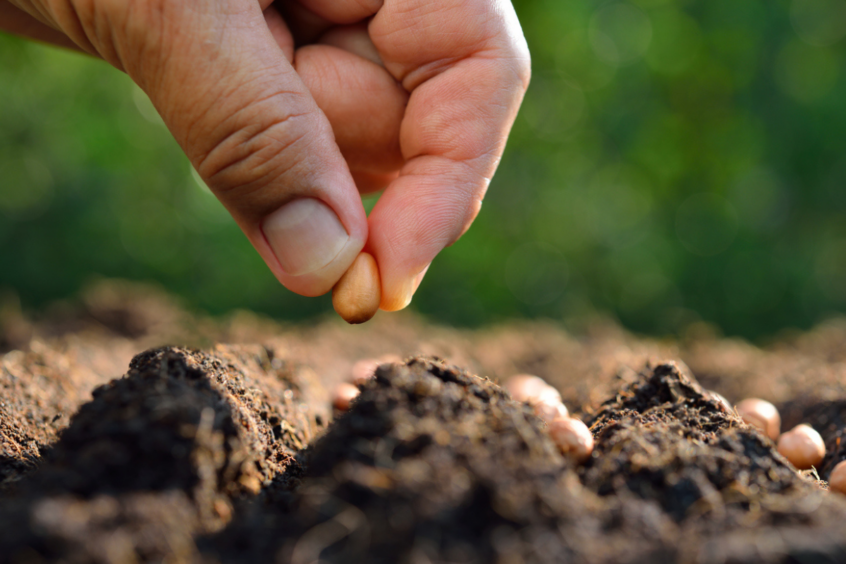
Why we keep planting when we can’t yet see anything grow?
I buried a good friend this week.
He died Monday, suddenly and without warning. By Friday we were standing at his funeral, most of us still not quite believing the week had happened.
He won’t make any headlines. There was no press release, no building named after him, no viral tribute thread. The funeral was not big. If you measured his life the way our culture measures lives — platform, reach, titles, followers — you’d file him under ordinary and move on to something more impressive.
But I got to see a side of him that most people never did.
I was his neighbor for eleven years, which means I saw the part of his week that almost nobody at church did.
8:15 on Sunday morning. Every Sunday. He’d come out his front door already dressed and ready to go, so consistently that I could have set my coffee by it. If it had snowed overnight, he’d been up long before that, clearing the driveway in the dark so that nothing would keep him from leaving on time. In eleven years, I’m told he missed twice.
He was going to serve kindergartners.
Not the pulpit. Not the church board. Kindergartners.
And the clockwork wasn’t only Sundays. 5:30 at the gym, every weekday morning. Before that, a chair and an open Bible in the first quiet part of the day, every day, for years. He knew the kindergartners’ names, and he carried those names into the week — I know, because I heard him pray them out loud. He loved his brother. He served his friends without announcement, usually before you got around to asking, and he did it as a genuinely friendly man rather than a dutiful one, which is harder and much rarer than it sounds.
He wasn’t spectacular. He was faithful — which turns out to be a different thing, and a rarer one.
And standing there this week, looking around at who came and listening to what they said, I kept thinking about a passage I’ve taught a hundred times and understood maybe a little better on Friday.
The Kingdom Grows Differently Than We Expect
In Luke 13, Jesus has just healed a woman who had been bent over for eighteen years. The synagogue ruler is indignant about the timing. The crowd is rejoicing. His opponents are humiliated. And in the middle of that mess — a contested, unimpressive, small-scale scene — Jesus asks a question that sounds almost out of place:
“What is the kingdom of God like? And to what shall I compare it?” (Luke 13:18)
He gives two answers.
The first is a mustard seed. A man takes it and throws it into his own garden. It grows into a tree, and the birds of the air nest in its branches. Small in, oversized out. Nobody photographs the planting. Everybody enjoys the shade.
The second is leaven. A woman takes it and hides it in three measures of flour — sixty pounds of dough, an absurd amount — until the whole batch is leavened. You can’t see it working. You can’t check on it. You can’t speed it up. And you can’t stop it, either.
Two pictures, one point: the kingdom of God does not scale the way we assume things scale. It starts smaller than seems reasonable and ends larger than seems possible, and the middle part is mostly hidden.
My friend understood this instinctively. I don’t think he could have explained it to you. He just kept planting.
He planted in the gardens that were his. Let me ask you about yours. There are three.
Planting Seeds by Pursuing Christ
Start here, because everything else grows out of this one.
My neighbor’s Sunday morning didn’t begin on Sunday morning. It began in a chair with an open Bible, every day. It continued in a men’s Bible study he showed up to every week, in a church he was more committed to rather than his retirement hobbies, and in books by authors who challenged him more than they comforted him. None of that was visible to the kindergartners. All of it was underneath what they got.
Jesus put this in front of us in Luke 10. Martha is busy with genuinely good work — hospitality, service, the meal that somebody has to cook. Mary sits at His feet. And Martha’s complaint is one every faithful person has felt: there is real work to be done, and sitting there isn’t doing it. But Jesus doesn’t scold Mary for being unproductive. He tells Martha she is anxious and troubled about many things, and that Mary has chosen the good portion, which will not be taken away from her.
Choosing to be Mary in a Martha world is a seed. It looks like the least urgent thing on your list every single morning.
And here is what twenty-five years of counseling has convinced me of: the people who stand up under crushing trials are almost never the people who started building in the trial. By the time the diagnosis comes, or the marriage cracks, or the job disappears, there is no time to grow a root system. There is only time to find out whether you have one.
You cannot plant a tree in a storm.
That’s not said to shame anyone who is in the storm right now with thin roots — most of us have been there, and God is remarkably kind to people who start late. The best time to have planted was twenty years ago. The second best time is tomorrow at 5:30.
But notice what my neighbor’s private seeds produced. Everyone around him got the fruit of a maturity that was grown somewhere they never saw. That’s how it works. You cannot give away from soil you never watered.
Planting Seeds by Prioritizing Family
The seeds you plant closest to home are the ones most easily crowded out, because family is the one audience that will still be there tomorrow whether you invest today or not. That’s exactly what makes it so easy to postpone — and so devastating when the postponing becomes a pattern.
In Your Marriage
In more than two decades of sitting across from couples in crisis, I have almost never watched a marriage die in a single afternoon. That’s not how it works. What I watch instead is a slow accounting of ten thousand seeds that were never planted. The question that never got asked. The apology that got postponed and then got permanent. The five minutes of attention that went to a screen for eleven straight years.
Nobody wakes up and decides to have a distant marriage. Distance is what grows in soil where nothing else was planted.
Here’s the hopeful flip side: I also almost never watch a marriage get rebuilt at a conference. I love conferences. I speak at them. But I’ve never seen a weekend fix a decade. What I have seen — repeatedly, in couples nobody would call remarkable — is mustard-seed faithfulness quietly producing a tree.
Seeds are unimpressive by definition. Don’t wait for something worthy of the problem you’re facing.
- The twenty-second turn. Your spouse says something minor — about their day, about the dog, about nothing. You can turn toward it or scroll past it. Twenty seconds. Four times a day for a year is fifteen hundred deposits.
- The early confession. Not the crisis confession, months late, dragged out of you. The one where you say, “That came out sharp, and I was wrong,” within about ninety seconds of it happening. Small repentance keeps soil soft. Delayed repentance requires a jackhammer.
- Praying together badly. Most couples who don’t pray together stopped because it felt awkward, so they’re waiting until they can do it well — which is to say, never. Thirty stumbling seconds beats a decade of intending to start.
- In your children. The parenting version of this mistake has a name in my office: The Big Talk.
We save it up, waiting for the right moment and the right maturity, planning one conversation substantial enough to matter. Then it lands like a lecture, because seven years of small deposits were supposed to be underneath it and weren’t.
Moses described discipleship as leaven instead: talk of them when you sit in your house, and when you walk by the way, and when you lie down, and when you rise (Deut. 6:7). Those aren’t summits. Those are Tuesdays.
The seeds are small enough to feel pointless. Three minutes at the edge of the bed instead of two. One question in the car that isn’t logistics. Letting them overhear you pray for them by name. Letting them watch you apologize to them, which does more for their doctrine of grace than any curriculum you’ll buy.
And here is the part that requires actual faith: you will very likely not see the germination.
I sit with parents of adult children who are looking for a lever — some conversation, some argument, some intervention proportional to their grief. There isn’t a lever. There’s soil. The seed you plant in a nine-year-old may not break ground until she’s twenty-seven and three states away and you are not in the room. That’s not failure. That’s farming.
Planting Seeds by Pouring Into Friends
Notice what Jesus says about the leaven: the woman hid it in three measures of flour. Sixty pounds of dough. That isn’t a personal loaf. Nobody bakes that much bread for themselves.
The kingdom spreads through a body, not a household.
And this is where many believers underestimate the impact they can make. Too many Christians have bought into the idea that care requires a professional — and that the rest of us can only provide a casserole. I have the privilege of training volunteer counselors in churches, and I can tell you plainly that some of the best care comes from ordinary friends who show up and stick around when times are tough.
You can be that kind of friend. The seeds are ordinary.
The text on the anniversary of the death, the one everyone else forgot. The second question — the one you ask after they say “fine,” because you actually want to know. Sitting in a hospital room contributing nothing but your body. Remembering the name of the thing they’re afraid of and asking about it six weeks later.
You will almost never learn what those seeds became. My friend didn’t. Half the people in that room this week were carrying something he planted and forgot about a decade ago.
Don’t Grow Weary
Here’s why we quit.
We quit because we quietly believe we’re responsible for the increase. And when we don’t see the harvest — in our spouse, in our kid, in our friend — we conclude the planting was wasted and we stop.
Paul cuts that off at the root. “I planted, Apollos watered, but God gave the growth. So neither he who plants nor he who waters is anything, but only God who gives the growth” (1 Cor. 3:6-7). Jesus says the same thing in Mark 4: the farmer sleeps and rises, night and day, and the seed sprouts and grows — he knows not how.
You are not responsible for the growth. You are responsible for the seed.
That’s not a lowering of the standard. It’s a relocating of the burden, and it’s the only thing that makes long obedience survivable. Because the great temptation of hidden work is to dig the seed back up and see whether it’s doing anything — and that isn’t diligence, it’s unbelief with a shovel.
“And let us not grow weary of doing good, for in due season we will reap, if we do not give up.” (Gal. 6:9)
In due season. Not on your calendar. Not with your name attached. Not necessarily in your lifetime.
Birds in the Branches
Here’s what I saw at that funeral.
The room wasn’t full of admirers. It was full of friends — from the gym, from the neighborhood, from a dozen corners of a life he never once thought to advertise. And there were kids there too, come to honor a man who had thought they were worth his Sunday mornings.
Branches, all of them. People whose lives had made a home in something he planted years ago, mostly when nobody was watching, often when he had no idea it would grow into anything at all. He never saw the tree. He just kept walking out his front door on Sundays at 8:15, and at all the other hours of the week when he quietly served the people around him.
Your own soul is a garden. So is your kitchen table. So is that pew you sit in every week. They are small. They are unimpressive on most Tuesdays. And they are exactly the size of thing Jesus says the kingdom of God is like.
Plant the seed. God gives the increase.
You may not live to sit in the shade. Someone will.





3 Comments on “Small Seeds, Oversized Impact”
Tim, first, I’m so sorry about the loss of your neighbor. What an amazing, faithful man he was. I lost a friend recently too, and I attended her memorial service this past weekend. Second, your article on the oversized impact of small seeds is powerful and compelling. Thank you for writing this! I pray that it will encourage and motivate us to live our daily lives with a renewed sense of purpose and priority to intentionally plant small seeds in our own spheres of influence.
Excellent article and beautiful perspective on life. It’s a reminder to me that some seeds take longer to sprout, and when they do sprout, take longer to mature.
Water faithfully.
Disciplining learning and teaching God’s word the Bible is a the only way to live in this sinfully evil world. We that have Jesus christ as are lord and savor have to tell everyone about Jesus.