

This article is part of our new series on Biblical Response to Mental Health month. In this series, our counselors hope to call churches and Christians to re-engage with the discussion and care for mental health struggles through a biblical lense.
A 50-year-old successful businessman named “Joe” is spiraling out of control, and everyone around him seems to know it — except him.
He sold his company during the pandemic for enough money to allow him to enjoy a good life for the rest of his life. The golf course and his boat have become his refuges, but increasingly he seems angry and depressed.
After taking out the neighbor’s mailbox while driving home one night, his wife found him on the front porch. He was crying and didn’t want to live like this anymore. The responding police officer suggested that his wife take him to the ER, where they admitted him into a short-term program. His wife picked him up from the hospital with doctor’s orders to continue getting help for his PTSD, depression, and substance abuse disorder.
As Joe followed through, various professional counselors focused on addressing thoughts and behaviors, seeking to give him true explanations for why he was acting out the way he was.
Some counselors focused on his family-of-origin concerns, others focused on current “stress triggers,” and others focused on addiction medical issues and chemical imbalances. Unlike leukemia or anemia, there are no blood tests to verify most conditions like PTSD or depression.
What Joe believes to be true about why he experiences these negative thoughts, feelings, and actions will guide many of his next steps.
Joe landed in my office with a single question: “What is the truth about why I did what I did? I know I made some bad choices, but I don’t think I’m mentally ill. I don’t know what to believe anymore.”
While all of his previous counselors and programs seemed to give him some truth in their explanations, he wasn’t comfortable moving forward without asking how his faith and the Bible might give him better answers.
He wanted truth — he kept remembering John 17:17, “Sanctify them in the truth; your word is truth.”
Joe believed that lasting change would only take root if it was based on the truth.
Here are three important biblical truths that relate to mental health and the heart.
Key Truth #1: Our hearts impact our mental health more than anything else.
In a previous article, we referenced this working definition: “Mental health includes our emotional, psychological, and social well-being. It affects how we think, feel, and act. It also helps determine how we handle stress, relate to others, and make choices.”
What that definition fails to see is that because the heart (inner man) is the primary source of our feelings, thinking, and actions, we must understand what the Bible teaches about the heart. It’s critical to our understanding of how we should respond to mental health.
Consider the themes of the following verses:
“Every man’s way is right in his eyes, but the Lord weighs the heart.” — Proverbs 21:2
“For from within, out of the heart of man, come evil thoughts, sexual immorality, theft, murder, adultery, coveting, wickedness, deceit, sensuality, envy, slander, pride, foolishness. All these evil things come from within, and they defile a person.” — Mark 7:21-23
“Keep your heart with all vigilance, for from it flow the springs of life.” — Proverbs 4:23
From a Christian and biblical perspective, the heart is the sources of our beliefs and convictions.
Our heart issues are the issues of life. Contrary to our popular notion that the “psychological realm” deals with the deepest issues of life, the bible teaches that we don’t have a deeper level of lived experience than the heart and the inner man.
When we are dealing with the heart, we are dealing with who God says we really are. Even the troubling behavior patterns we are stuck in are shaped by the commitments and conditions of our hearts.
In his book The Dynamic Heart in Daily Life, Jeremy Pierre describes the importance of valuing the heart in responding well: “The dynamic heart responds to God, to self, to others, and to circumstances. These four contexts are vital to recognize when considering a person’s experience of the world. The most important context of the heart’s response is God himself.”
A. W. Tozer got it right when he said, “What comes into our minds when we think about God is the most important thing about us.”
The heart was custom-made for worshipping God, and the closer it comes to that design, the better it works. In fact, when the heart responds rightly to God, it will respond rightly to everything else.
People were created to worship God in thought, desire, and choice.
The chart below represents the dynamic nature of life and how even God Himself needs to be included in how we respond to the trials and difficulties of life, including mental health disorders.
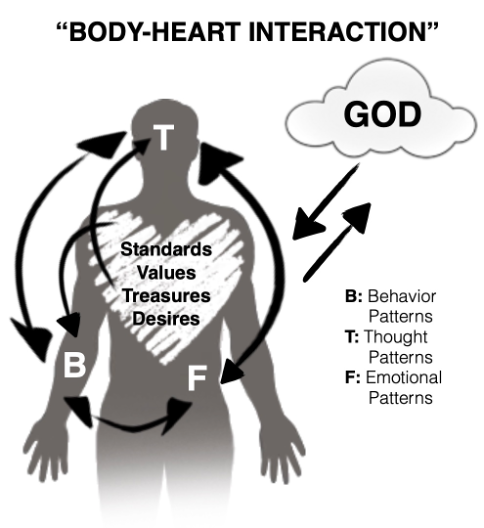
The Bible doesn’t teach us to view physical weakness as a sin issue, nor does it teach that physical weakness has no impact on our cognitive or physical capabilities. However, the Bible is clear that our hearts evidenced by renewed mind — not our brains or physical bodies — will be the most important target for personal transformation.
Our behavior patterns, thought patterns, and related emotions are all influenced most by the health of the heart. For this reason, Jesus spoke to heart issues most often.
This is why two different people can have very different responses to the same sorts of stressors. What they believe to be true will shape how their body and mind respond to their circumstances. The difference in response cannot be explained by merely a difference in their physical bodies; their lived experience and values will impact their responses far more than their DNA.
Most current treatments for mental health disorders are missing a biblical understanding of the heart. Instead, they only focus on the physical aspects and seek transformation through behavioral or emotional modification. The spiritual is viewed as irrelevant to the treatment of mental health.
Key Truth #2: Our mental health really describes what our hearts believe to be true about ourselves and God.
A humanistic understanding of man believes that we are simply habituated as we run from the traumas of life and seek the treasures found in freeing our “true self” from unwanted inhibitions. This inevitably leads to man-centered therapies.
We are created by God for a purpose, and our true self will only be found in pursuing God’s purpose and inclining our hearts toward God. This is a controversial proposition from a secular counseling perspective.
When churches have conversations about mental health and develop strategies that primarily focus on the physical rather than the spiritual, they can actually undermine the healing of both the spiritual and the physical.
So, can the spiritual life actually bring healing to our physical body? The answer is yes! Both the Bible and the personal experiences of many believers are clear on this.
Our spiritual life transforms how we think, feel, and act — and our mental health reveals what our hearts have come to believe.
One of the key questions in helping anyone with a mental health disorder is, “Who do you think you are, and who do you think God is?” These are not just secondary conversations to the physical concern.
Our thoughts about ourselves, God, and others are complicated by years of experience and beliefs that are well-worn in our thoughts and brains. However, we can’t be faithful in conversations about mental health without seeking to understand and grow the spiritual condition of the heart.
Key Truth #3: Solutions to mental health that ignore spiritual health create greater dysfunction than the dysfunctions they desire to heal.
This is a sobering reality, but one we can’t afford to ignore. When treatment plans address the symptoms of mental health struggles while leaving the heart untouched, they often deepen the very wounds they were meant to heal.
Why? Because they can teach a person to manage their suffering apart from God rather than to find their hope in Him. They may relieve some pain in the short term, but they leave the soul without an anchor. The deepest questions — Who am I? Why am I here? Is there hope for me? — go unanswered, or worse, are answered in ways that pull a person further from the only One who can truly heal.
Consider what often happens when the spiritual is set aside:
- A person learns to identify with their diagnosis rather than with Christ.
- Coping strategies replace repentance, and self-management replaces sanctification.
- Hope becomes tied to a treatment plan, a medication, or a therapist — rather than to the steady presence of God Himself.
- Suffering loses its meaning, becoming only an obstacle to remove rather than a path God can use to draw us closer to Him.
None of this is to say that counseling or medical care are wrong. They’re not. Good medical care can bring genuine relief and stability. But when they become the whole of someone’s care for their mental health, they crowd out the very thing the soul most needs. We need a renewed mind and growth in our dependence on God, for when we are weak, he is strong.
Joe’s question — “What is the truth about why I did what I did?” — was the right one. Until that question is answered in light of God’s truth, no amount of behavioral or chemical adjustment will bring the lasting change his heart is longing for.
Healing that ignores the heart isn’t really healing. It’s management. And management without Christ eventually wears thin, often leaving people more discouraged, more isolated, and more confused than when they started.
The good news is that there is a better way. The gospel speaks directly into the heart and offers what no therapy or prescription can: forgiveness, purpose, identity, and the unshakeable love of God.
Conclusion
Much of the cutting-edge research on psychiatric disorders completely ignores the heart.
Psychedelics and electroshock therapy are even making a comeback recently, attempting to shake up patterns of thinking that feel so entrenched. At best, they will change the capacity of the brain to think more clearly about oneself, but ultimately the real battle in any mental health disorder is understanding the heart’s motivation.
The Bible is full of rich teaching, vivid illustrations, and life direction for those who truly desire to have a healthy heart.
We need to trust what the Bible says and patiently work with those who need restoration, just as we have needed it at times ourselves. Bring them to Jesus and His Word for the transformation of their heart that only He can provide.
[1] https://www.mentalhealth.gov/basics/what-is-mental-health





3 Comments on “Mental Health, Theology, and Why the Heart Matters”
Thank-you so very much. I appreciate that you put God first in how/what I think/feel. I am still working at getting help for my husband, these articles give me the hope I need that he will see the truth of God’s word and be able to practice what God wants for himself (and me).
Thank you for an excellent article! My father had years of mental health issues and it seemed hopeless that it would ever change. Then he met Jesus! What an immediate and radical change for all to see as he gave clear testimony to God’s redemption in his life! It was the power of the written Word that brought him to the Living Word and redemption!
Mental health issues in to be addressed if you know or don’t know you have a problem. Jesus Christ is the answer to alot of people’s problems. But every once in a while please need to see a doctor and get put on medicine. But if a person doesn’t know Jesus they need to turn to Jesus 100persent God living for God obeying and following God praising and worshiping Jesus reading God’s word the Bible. Thank you all, God bless you all.